
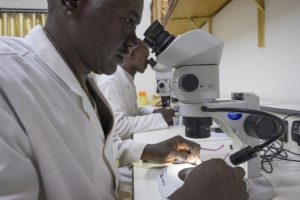
Target Malaria is proceeding with steps to develop sustainable genetic technology for malaria control at a low cost. Small-scale release of sterile male mosquitoes is part of the first step of the project development. It aims to collect scientific data that will inform the next steps in the development of technology. More specifically, it will provide information on the target mosquitoes’ survival rate, the distances travelled and their ability to participate in swarms.
These mosquitoes have a very short life span; they will quickly disappear from the environment and cannot reproduce.
What will happen to the GM sterile male mosquitoes released into the environment? How will you address any negative impacts that may arise from the release?
Safety is of paramount importance to our project and there is no indication that this release will cause any harm to human health or the environment. These mosquitoes will not stay for long in the environment; they will disappear after a few weeks. The nature of genetic modification means that the gene of interest will quickly disappear from the environment after release. Males that have been released are sterile and therefore cannot have offspring.
NBA rigorously conducted the risk analysis before making its decision. It has carried out a meticulous and rigorous evaluation taking into account all potential risk issues related to human and animal health and the environment.
How are you going to recapture all these mosquitoes?
The purpose of the release is not to recapture all the mosquitoes released. During the ten (10) days of recapture, the research team will recapture more mosquitoes than those that were released. The technique of “tagging, release, recapture” is a well-known method practiced all over the world by entomologists. It enables us to estimate the daily survival rate of these mosquitoes and to assess their movement at the release site. Let us remember that the mosquitoes we released are male and sterile, and therefore cannot produce offspring.
Can we be sure that everything is under control?
We have been working for many years; we have followed all the biosafety and safety rules and the precautions that are needed in such work, and this allows us to be serene and confident about the future of research against malaria.
I would like to tell our people that our research institutions have a proven expertise record. We are Burkinabè and our ambition as human beings and as researchers, who grapple with malaria, is to give our contribution for the health of our people. We are deeply convinced that we can do something, and if throughout centuries, men, by their intelligence, were able to overcome diseases by research, we must follow this path. Our work is transparent and respectful of ethical and deontological rules, and is conducted by researchers who live with communities and work with them in a spirit of dialogue. Even though the path is still long, together we will triumph with dialogue and respect.
This interview has been translated and re-published, with permission, from Infos Sciences Culture. For more information, contact Cyr Payim Ouedraogo on cyrouedraogo43@gmail.com